Posts


https://www.vultr.com

The Everywhere Cloud

Deploy an instance.
Accelerate your application.


Loads - Note 2

Image
A SIMPLE COMPARISON OF SYNCHRONOUS AND INDUCTION MOTORS Synchronous Motor = stator windings are the same as those of induction motors = rotor windings are usually flexible copper coils connected to a separate DC exciter = the DC excitation supplied to the field coils produces the rotor magnetic flux = constant speed from no-load to full-load, but may stop when overloaded = works as power factor corrector while providing stable torque to drive loads Induction Motor = stator windings are the same as those of synchronous motors = rotor "windings" are usually rigid aluminum bars, skewed and short-circuited at each end = self-excited via induction like a transformer to produce rotor magnetic flux = variable speed based on frequency, but can be affected by harmonics = can provide high torque to accommodate temporary overloads Each has an advantage, depending on the desired application.

Loads - Note 1

Image
MOTOR EFFICIENCY DISSECTED ANALYSIS 1.) Law of Conservation of Energy (ideal): W,in = W,out 2.) First Law of Thermodynamics (practical): Q = W + dU Total energy = Work done + change in Internal energy W,in = W,out + W,losses W,in > W,out Energy input is always greater than energy output because of energy losses. 3.) Utilizing energy through time: (W,in / t) = (W,out / t) + (W,losses / t) 4.) Power and energy relationship: P = W / t P,in = W,in / t P,out = W,out / t P,losses = W,losses / t 5.) Power flow equation: P,in = P,out + P,losses P,in > P,out Power input is always greater than power output because of power losses. 6.) Usable power and energy: efficiency = (P,out / P,in) * 100 efficiency = (W,out / W,in) * 100 SUMMARY Motor efficiency is all about how well a motor converts energy input into energy output, given imperfections like friction and waste heat.

Circuits - Scenario 3

Image
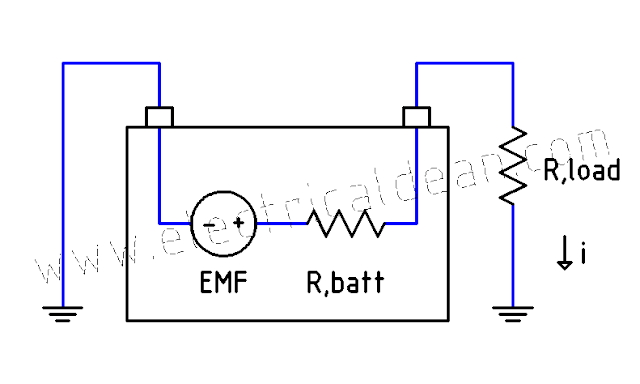
SITUATION A defective battery is found to have excessive heat losses during quality control tests. How its internal resistance determined to verify if it matches with its original design specification? ANALYSIS 1.) One-line diagram: o|---EMF,batt---R,batt---R,load---|> EMF,batt = battery internal electromotive force R,batt = battery internal resistance R,load = dummy load resistance 2.) Ohm's Law: V,load = i * R,load i = V,load / R,load 3.) KVL: (-EMF,batt) + i * (R,batt + R,load) = 0 (-EMF,batt) + (V,load / R,load) * (R,batt + R,load) = 0 (-EMF,batt) + (V,load / R,load) * R,batt + V,load = 0 V,load (R,batt / R,load) = EMF,batt - V,load R,batt / R,load = (EMF,batt / V,load) - 1 R,batt = [ (EMF,batt / V,load) - 1 ] * R,load At no load: V,NL = EMF,batt At full load: V,FL = V,load R,batt = [ (V,NL / V,FL) - 1 ] * R,load CONCLUSION The internal resistance of a battery can be determined by measuring its no-load voltage, then placing a known resi...

Trivia - Electric Mnemonic 2

Image
This post presents an alternative way of memorizing the color code of resistors. 1.) Resistor colors are arranged as follows: Black (0), Brown (1), Red (2), Orange (3), Yellow (4), Green (5), Blue (6), Violet (7), Gray (8), White (9) 2.) At first glance, they may seem hard to remember even though there are only ten of them. But upon closer inspection, the colors are logically arranged from "darkest" to "lightest". BB, ROYGBV, GW Therefore, they can be categorized to shorten memorization, with only a few colors per category. "2 Dark, 6 Rainbow, 2 Light" or simply, "Dark Rainbow Light" 3.) For those who like to memorize on per-letter basis, they can also be expanded into "sentence" form. BB ROYGBV GW "Bell Boy ROY G. BiV Gets Water" "Boss Baby ROY G. BiV Got Wet" "Bad Boy ROY G. BiV Gave Weapons" "Big Bad ROY G. BiV Goes Wild" ... and so on. 4.) As for resistor tole...

Loads - Scenario 3

Image
SITUATION Lamp 1 and Lamp 2, operating in parallel across 230 Volts, dissipate rated power at 100 Watts and 60 Watts respectively. How much power will each lamp dissipate if they are connected in series? ANALYSIS 1.) Parallel operation 1.1.) Power: P,1 = 100W P,2 = 60W 1.2.) Resistance: R,1 = (V)^2 / P,1 R,1 = (230V)^2 / 100W = 529 ohms R,2 = (V)^2 / P,2 R,2 = (230V)^2 / 60W = 881.67 ohms 2.) Series operation 2.1.) Current: V = i * (R,1 + R,2) i = V / (R,1 + R,2) i = 230V / [(529 + 881.67) ohms] i = 0.16A 2.2.) Power: P,1 = i^2 * R,1 P,1 = (0.16A)^2 * 529 ohms = 13.54W P,2 = i^2 * R,2 P,2 = (0.16A)^2 * 881.67 ohms = 22.57W CONCLUSION When connected in series, Lamp 1 dissipates around 13.5 Watts while Lamp 2 dissipates around 22.6 Watts. Both outputs decrease significantly, but Lamp 2 now has a higher power output than Lamp 1.